
News Stories

‘Avatar 2′ Diving Underwater; James Cameron Instructs Michael Bay To Save 3D

[thefilmstage.com, by Jordan Raup]

With the news that James Cameron will be shooting Avatar 2 and 3 back-to-back for 2014/15 releases, we have yet to get any concrete story details. Last April, he told Hero Complex that he is going to “focus on the oceans of Pandora” but not much else. We now get a small update from the original’s Michelle Rodriguez.

Although she (*spoiler*) dies in the 2009 mega-blockbuster, she thinks there is a chance to return but Cameron hasn’t offered her anything. If Sigourney Weaver thinks she is returning, I suppose any character can. In the interview with AP, Rodriguez also confirmed and expanded Cameron’s “ocean” comment, saying the sequel “will take viewers underwater and will be extraordinarily beautiful.”

Knowing the director’s fascination with the sea, it will be interesting to see if the majority of the film will take place underwater a la The Abyss or if he will explore something entirely different. Massive floating water bubbles anyone? Some of the most impressive visuals from the the first were the water effects (see Jake’s waterfall jumping exploits), so I think it would be a fascintating area to explore.
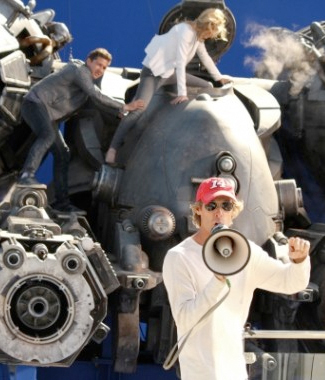
In other news, we all know the most powerful directors in Hollywood love to hang out and comment on each other’s work. Empire recently sat down withTransformers: Dark of the Moon director Michael Bay to talk his career. Aside from saying the mystical elements in Transformers: Revenge of the Fallen were “crap” and that “it was just terrible to do a movie where you’ve got to have a story in three weeks,” he had some words about 3D.

Although he was apprehensive about the format at first, James Cameron said to him: “Mike, directors like you have to do 3D or it is going to die.” It’s unclear whether Cameron meant that in a sense of the biggest budget films of the year should have 3D so audiences have no choice but to see it, or if he actually believes in Bay’s artistic approach to the format. Spoken like a true artist, Bay did say “the size, the girth, and the weight” of 3D “works really well with the robots…it’s spectacular.” All of you morons on the internet better get ready.

Avatar 2 hits theaters late 2014 and Transformers: Dark of the Moon comes out July 1st, 2011.

See the original post here: http://thefilmstage.com/2011/03/06/avatar-2-diving-underwater-james-cameron-instructs-michael-bay-to-save-3d/


Lord of the Dance in 3D

[Stereoscopynews.com, no author given]

Lord of the dance 3D will be released mid-March in UK, USA, and Canada. This dance show by Michael Flatley was shot in November 2010 in UK and Ireland by Marcus Viner, produced by Vicki Betihavas over 5 evenings with 5 3D camera rigs giving 25 3D camera positions to play with in post.


Millions of people around the world have been enchanted by Lord of the Dance. Since its premiere in 1996, it has been captivating audiences and critics around the globe and has grossed over ONE BILLION dollars worldwide. However, no one has ever had the opportunity to experience the magic, excitement, and passion by being part of the performance, until now, when LORD OF THE DANCE is released in 3D for one week only around March 17th.

Lead stereographer: Kommer Kleijn SBC, stereographer: Adam Sculthorp.

Lord of the dance 3D is here on the web.

See the original post here: http://stereoscopynews.com/hotnews/3d-movies/musicals/1314-lord-of-the-dance-3d.html


< PREVIOUS ARTICLES NEXT ARTICLES >

Specification for Naming VFX Image Sequences Released

ETC’s VFX Working Group has published a specification for best practices naming image sequences such as plates and comps. File naming is an essential tool for organizing the multitude of frames that are inputs and outputs from the VFX process. Prior to the publication of this specification, each organization had its own naming scheme, requiring custom processes for each partner, which often resulted in confusion and miscommunication.

The new ETC@USC specification focuses primarily on sequences of individual images. The initial use case was VFX plates, typically delivered as OpenEXR or DPX files. However, the team soon realized that the same naming conventions can apply to virtually any image sequence. Consequently, the specification was written to handle a wide array of assets and use cases.

To ensure all requirements are represented, the working group included over 2 dozen participants representing studios, VFX houses, tool creators, creatives and others.  The ETC@USC also worked closely with MovieLabs to ensure that the specification could be integrated as part of their 2030 Vision.

A key design criteria for this specification is compatibility with existing practices.  Chair of the VFX working group, Horst Sarubin of Universal Pictures, said: “Our studio is committed to being at the forefront of designing best industry practices to modernize and simplify workflows, and we believe this white paper succeeded in building a new foundation for tools to transfer files in the most efficient manner.”

This specification is compatible with other initiatives such as the Visual Effects Society (VES) Transfer Specifications. “We wanted to make it as seamless as possible for everyone to adopt this specification,” said working group co-chair and ETC@USC’s Erik Weaver. “To ensure all perspectives were represented we created a team of industry experts familiar with the handling of these materials and collaborated with a number of industry groups.”

“Collaboration between MovieLabs and important industry groups like the ETC is critical to implementing the 2030 Vision,” said Craig Seidel, SVP of MovieLabs. “This specification is a key step in defining the foundations for better software-defined workflows. We look forward to continued partnership with the ETC on implementing other critical elements of the 2030 Vision.”

The specification is available online for anyone to use.

Oops, something went wrong.